When brands sound the same, growth slows. This article explores why brand differentiation is collapsing across industries and how research-driven brand positioning and brand strategy help companies create meaningful distinction, accelerate growth, and strengthen pricing power.
Across B2B and D2C, brands now sound interchangeable. The language is polished. The claims are rational. The value propositions are nearly identical. Innovative. Customer-centric. End-to-end. AI-powered. Trusted. Every brand says some version of the same thing.
The result is not confusion. It’s indifference.
Buyers are not struggling to understand brands. They simply do not see meaningful differences between them. Evaluation turns transactional. Choice shifts from preference to convenience and from value to price.
The cost shows up quietly. Slower growth. Longer sales cycles. Compressed margins. Fewer reasons to choose you when scrutiny increases or budgets tighten.
This did not happen because brands stopped investing in marketing. It happened because brands tried to differentiate through words while the market redefined what actually creates value.
As categories matured and barriers to entry fell, new competitors emerged that did not look like the incumbents they were disrupting. Smaller brands. New models. Adjacent players. While established brands refined their language, the market quietly rewrote the definition of value.
To rebuild differentiation, brands have to step back before they zoom in. Before positioning, before messaging, before creative.
According to Gartner, 77% of B2B buyers say their most recent purchase was complex or difficult largely because suppliers sounded the same. When differentiation is shallow, buying feels risky.
The market is not confused. It is unconvinced.
Differentiation is decided before positioning begins
Before a brand decides how to differentiate, it has to understand what actually drives choice in the category. Not what buyers say they care about in isolation, but what consistently tips decisions when trade-offs are real. The strongest differentiation strategies are grounded in research and analytics that separate table stakes from true decision drivers and expose where your brand has permission to stake a claim relative to the competitive set.
Positioning without these insights is guesswork, not strategy. When brands skip this step, they default to saying familiar things louder or more cleverly. When they do it well, differentiation becomes a business decision, not a communications one.
A finer lens on what differentiation actually is
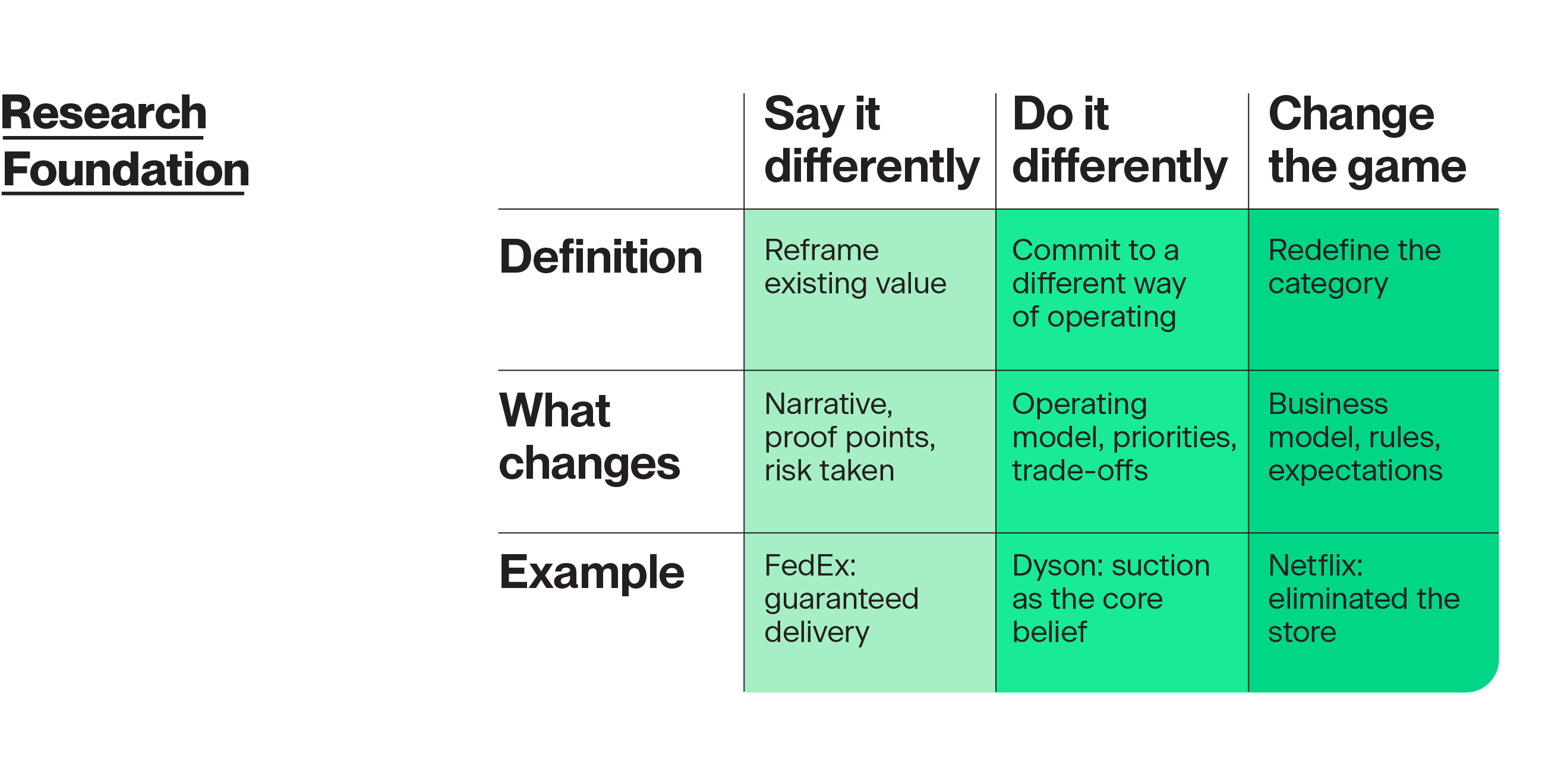
Real differentiation tends to fall into three paths. The most successful brands choose deliberately, then align the organization behind that choice.
Say it differently
This is not about clever language. It is about taking the primary decision driver in the category and making it impossible to ignore.
FedEx did not win by talking about moving packages from point A to point B. Everyone did that. Speed and reliability were already the price of entry, and every competitor claimed them. The unlock was the guarantee. It talked about the benefit differently: “When it absolutely, positively has to be there overnight,” and offered a money back guarantee to match it.
That shift did not invent a new decision driver, it reframed logistics around certainty and trust. Reliability became the differentiator because FedEx was willing to stand behind it financially.
The language mattered. What made it break through the sameness was the consequence attached to it.
This path works when a strong capability is undervalued or diluted by generic category language. It fails when the business cannot consistently deliver on the promise.

Do it differently
This is where many brands stop short because it forces real trade-offs.
In the vacuum category, competitors talked endlessly about features. Swivels. Attachments. Reach. Dyson ignored the clutter and anchored its brand on one idea: suction.
Not as a spec, but as a belief anchored to a benefit. Stronger suction meant better performance everywhere. That focus reshaped R&D, testing, design, and pricing. The message was simple because the commitment was deep.
Dyson did not out-message competitors. It out-decided them.
This path works when leadership is willing to narrow focus, fund the trade-offs, and protect the choice over time.

Change the game
This is not improvement. It is disruption.
Netflix did not try to become a better video rental store. It eliminated the store. By removing late fees, physical inventory, and physical trips, it rewired consumer expectations.
Blockbuster was not out-marketed. It was leapfrogged.
This path requires seeing the real competitive threat early, often before it looks like competition at all.

Differentiation is not what you say. It is what customers experience and reward.
One of the most common brand myths sounds like this: “We’ve been around for 100 years. That equals trust.” Internally, that feels true. Externally, research often shows something else. Longevity can signal credibility. It can also signal slow, rigid, or out of touch.
This gap shows up repeatedly when you separate what buyers say matters from what actually influences decisions.
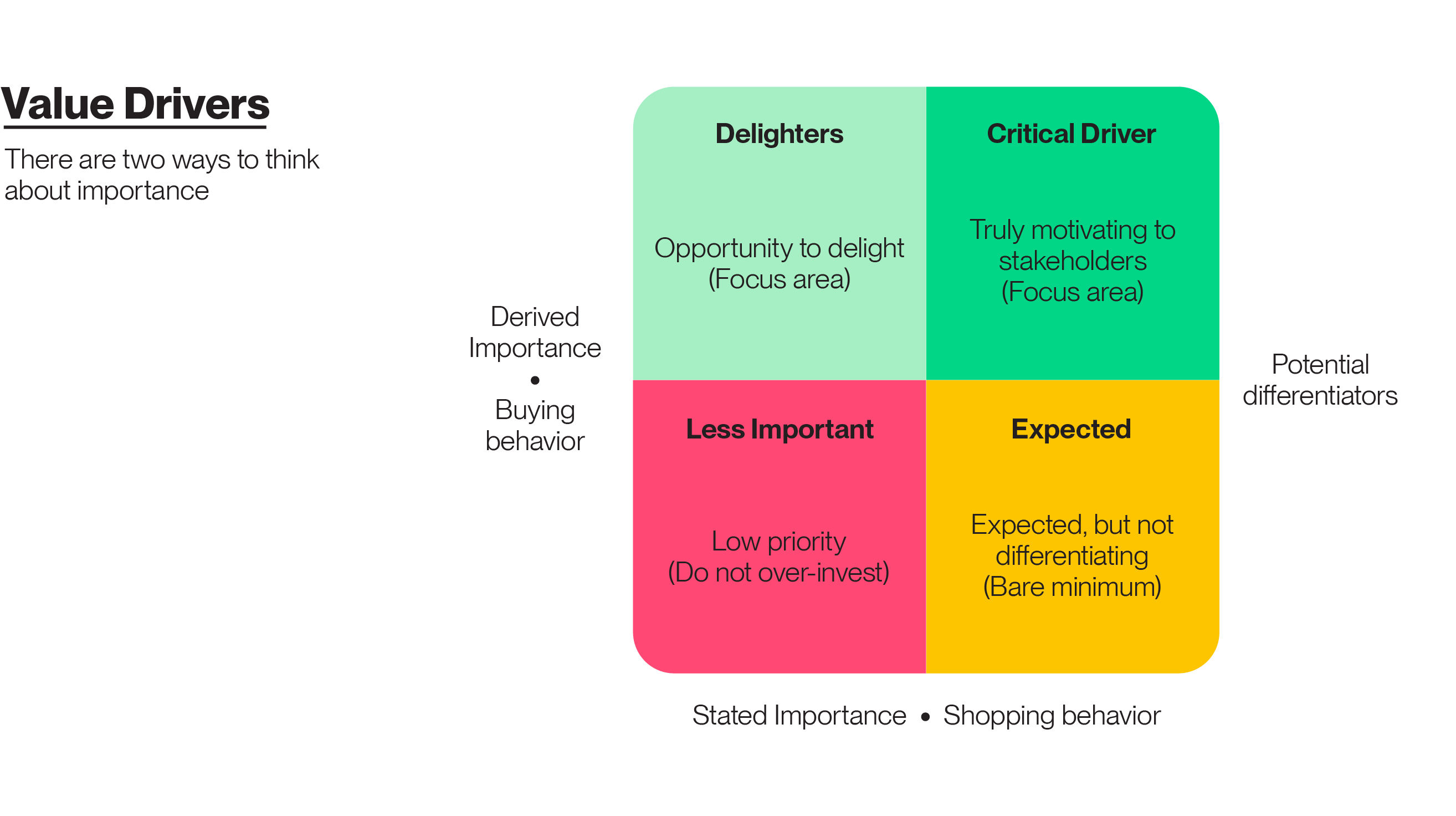
Most organizations anchor positioning on stated importance. The attributes buyers easily name because they are familiar and expected. Scale. Reliability. Feature depth. These are necessary to get in the consideration set, but they rarely differentiate. Over-investing here rarely changes outcomes.
Real differentiation lives in derived importance, the factors that shape behavior even when buyers do not articulate them.
This is why differentiation cannot be self-declared. What companies believe sets them apart is often table stakes.
The strongest differentiated positioning sits at the intersection of shopping behavior (stated importance) and actual buying behavior (derived importance). Research becomes strategic when it reframes how buyers evaluate options.
The AI trap looks familiar
The patterns behind differentiation collapse tend to repeat when new capabilities emerge. AI is no exception.
AI is following the same pattern as innovation and digital transformation before it. Everyone claims it. Few make it meaningful.
Buyers do not value AI itself. They value what it enables. Faster decisions. Greater accuracy. Less friction. Better outcomes.
Research shows repeatedly that when AI is positioned as a feature, it blends in. When it is positioned as an enabler of a clearly differentiated benefit, it strengthens the brand.
That distinction matters more now because it no longer lives only in marketing channels.
As buyers increasingly rely on AI systems to compare options, explain trade-offs, and justify decisions, vague claims collapse quickly. AI surfaces what it can clearly explain.
Brands that define value precisely—who they are for, what they do better, and why that advantage holds, are the ones that grow and scale.
.png)
Why this lands on the CMO’s desk
Once strategic differentiation is understood as a business choice, not a messaging exercise, it becomes a CMO issue because they sit at the intersection of growth, perception, and execution. They see misalignment first when internal belief drifts from market reality.
Many organizations still treat differentiation as a communications problem. A better story. A sharper value proposition. A stronger campaign. That is insufficient.
Differentiation only works when it shows up in how the business operates and in the experience it delivers.
When positioning is right, it reduces friction in demand. Increases conversion. Shortens sales cycles. Improves pricing power. Lowers acquisition costs.
The strongest CMOs use research and analytics to pressure-test positioning before it hardens into campaigns, roadmaps, and sales scripts.
The uncomfortable truth
Differentiation today is not about being louder or more clever. It is about being more precise.
Define the real competitive set. Define your highest value customers and what matters most to them. Choose how you will differentiate. Validate that choice against how the market actually sees you. Then operationalize it across product, service, sales, and experience.
Brand becomes a growth lever only when it constrains choice, aligns decision making, and sets clear priorities across the business.
Everything else is just words.